Trading Strategy
What a Perfect Trade Looks Like: How to Identify High-Probability Trend Line Setups
Every trader searches for the “perfect trade.” But the truth is, perfection in trading does not mean guaranteed profits. A perfect trade is not about certainty—it’s about probability, structure, and disciplined execution.
In this post, we break down exactly what a perfect trade looks like, how to identify it in real market conditions, and how to execute it with a clear, rule-based approach using trend line structure.
What Is a “Perfect Trade” (and What It Is Not)
A perfect trade does not guarantee a winning outcome.
Even when:
All technical conditions align
The setup checks every box
Risk is clearly defined
The trade can still lose.
Trading is a probability game. The purpose of identifying a perfect trade—also known as an A+ setup—is not to eliminate risk, but to consistently put yourself in high-probability situations while cutting out noise and randomness.
Most traders fail not because their strategy doesn’t work, but because they take too many mediocre setups instead of waiting for their best ones.
Why Trend Lines Matter
Trend lines simplify price action.
They:
Reveal market structure
Show overall momentum
Turn complex charts into readable information
Provide objective decision-making points
Rather than guessing or predicting, trend lines allow traders to react to price behavior.
This reaction-based approach is the foundation of a disciplined trading system.
The Two Types of Trend Lines
There are only two types of trend lines:
1. Upward Trend Lines
Connect higher lows
Indicate upward momentum
Signal bullish structure
2. Downward Trend Lines
Connect lower highs
Indicate bearish structure
Signal downward momentum
Trend lines are not just visual aids. They are tools used to determine when to enter and when to exit the market.
The A+ Setup: The Three-Touch-Point Trend Line Break
The core setup discussed here is the three-touch-point trend line break—a clean, rule-based strategy built entirely on price action and structure.
This is a repeatable, objective setup designed to remove emotion from decision-making.
Why Three Touch Points Matter
A trend line must have three confirmed touch points to be considered valid. Fewer than three reduces reliability. Three or more establishes structure.
The Action Line: Your Entry Signal
Before price breaks a trend line, it’s simply a trend line.
Once price breaks it, the line earns a name:
the action line.
The action line signals one thing:
It is time to take action and enter the trade.
This removes hesitation and subjective decision-making.
The Safety Line: Your Risk Management System
Every trade must have risk defined before entry.
The safety line:
Is the opposing trend line
Acts as your risk boundary
Determines when to exit the trade
As long as price respects the safety line, you stay in the trade.
The moment price breaks the safety line, you exit—no exceptions.
This ensures:
Risk is capped
Losses are controlled
Capital is protected
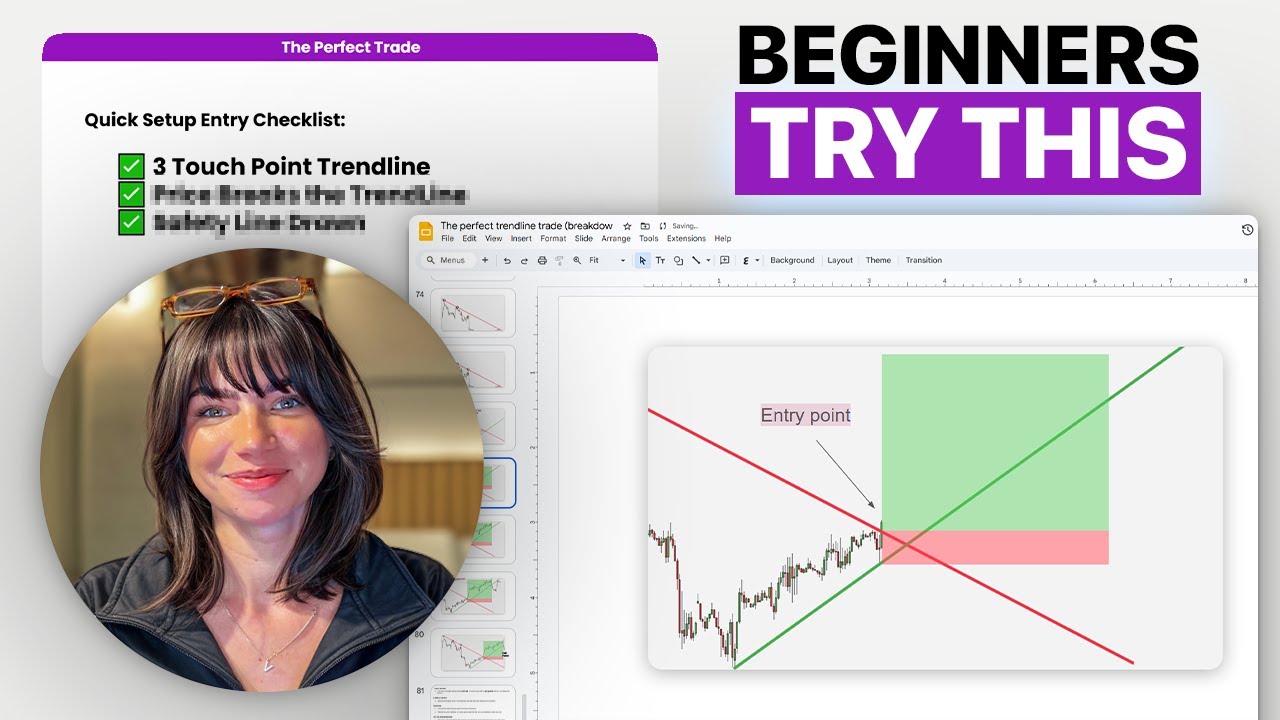
The Complete Perfect Trade Checklist
A valid three-touch-point trend line break must meet all of the following:
A trend line with three confirmed touch points
Price breaks the trend line (action line)
A clearly drawn opposing safety line
Entry on the break
Exit when price breaks the safety line
If any step is missing, it is not a perfect trade.
Real-World Application: How Trades Actually Play Out
In live markets:
Price may chop
Pullbacks may occur
Trades may stall before continuation
That does not invalidate the setup.
What matters is that:
Entry followed the rules
Risk was defined
Exit occurred at the safety line
Some perfect trades will fail. That is normal. The goal is long-term consistency, not perfection on individual trades.
Why This Strategy Works
This approach works because it is:
Rule-based
Structure-focused
Emotion-free
Scalable across timeframes
It allows traders to:
Take fewer, higher-quality trades
Avoid overtrading
Stay disciplined during drawdowns
Build confidence through process, not outcomes
Final Thought: Trade Less, Trade Better
Perfect trades do not appear constantly.
The edge comes from:
Patience
Selectivity
Discipline
Your job as a trader is not to be in the market all the time.
Your job is to be in the market only when conditions are right.
Focus on taking more A+ setups and eliminating mediocre ones—and consistency will follow.