Trend Line Trading

Trend Line Trading Masterclass: A Complete A-to-Z Guide to Structure, Entries, and Risk Management
Trend line trading is one of the most effective—and most misunderstood—approaches in technical analysis. When used correctly, it provides clear structure, objective entries, and disciplined exits without relying on indicators or unnecessary complexity.
This masterclass is a complete A-to-Z breakdown of how to trade trend lines professionally, using the same framework I’ve applied for over a decade in live markets.
Whether you are a beginner learning the foundations or an experienced trader refining your edge, this guide is designed to be practical, realistic, and executable.
Realistic Expectations Before You Start
Trading is not a shortcut to instant wealth.
The biggest reason traders fail is not strategy—it’s expectations. Trading is a skill that must be developed over time, just like any profession. Consistency comes from patience, discipline, and repetition, not from watching a single video or copying random trades.
This strategy works if you do.
How Trading Actually Works
At its core, trading is simple:
Buy an asset at one price
Sell it at another price
Capture the difference
You can make money when markets move up or down. Profit is not dependent on bullish conditions—it depends on correct analysis and execution.
Understanding Candlesticks (The Language of Price)
Candlesticks show:
Open price
Close price
High and low of the session
Green candles represent upward movement.
Red candles represent downward movement.
The wicks show how far price moved before settling. Understanding this is essential because trend lines are built from price movement, not indicators.
The Markets You Can Trade
Trend line trading applies universally across markets:
Forex – currencies traded 24/5
Crypto – highly volatile, traded 24/7
Stocks – equities traded during market hours
Futures – commodities, indices, metals, and energies (my primary market)
Because this strategy is based purely on price action and structure, it works across all of them.
The Three Market Conditions
Markets only do three things:
Uptrend (Bullish) – price moves higher over time
Downtrend (Bearish) – price moves lower over time
Consolidation (Range) – price moves sideways
Trend lines help you identify which environment you’re in and how to trade it.
What a Trend Line Really Is
A trend line is a diagonal line that connects key points in price movement to define market structure.
Upward trend lines connect higher lows
Downward trend lines connect lower highs
These lines are not decorative—they are decision-making tools.
Support and Resistance (When Price Moves Sideways)
When markets consolidate, support and resistance replace trend lines.
Support = floor (price repeatedly bounces upward)
Resistance = ceiling (price repeatedly rejects downward)
Support and resistance become even more powerful when aligned with trend lines.
Order Types: How You Enter the Market
There are two core order types:
Market Orders – immediate entry or exit at current price
Limit Orders – planned entries or exits at a specific price
Professional traders plan their trades. They don’t chase price.
Take Profit and Stop Loss (Non-Negotiable)
Every trade must include:
Take profit – locks in gains
Stop loss – limits losses
Losses are part of trading. The goal is to keep them small enough to remain in the game long term.
A common risk guideline:
Risk no more than 1–3% of your account per trade.
The Importance of Risk Management
Even the best strategy fails without risk management.
Losses should feel like:
Business expenses
Transaction fees
A normal cost of participation
If one trade can damage your account significantly, risk is too high.
Strategy Over Strategy-Hopping
Consistency does not come from trying new strategies constantly.
I’ve used the same core strategy for over 10 years.
Confidence comes from:
Understanding what you’re doing
Knowing why you’re doing it
Repeating it until execution becomes automatic
Simplicity is a competitive advantage.
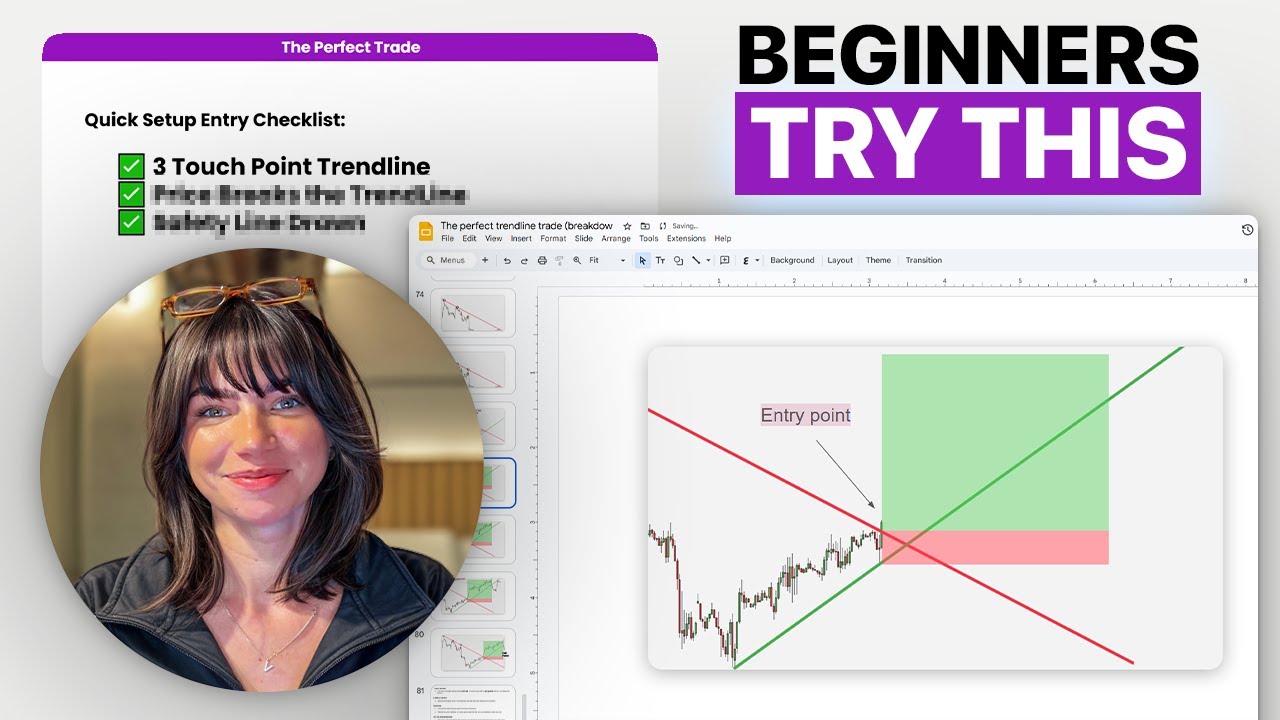
The Three-Touch-Point Trend Line Break Strategy
This is the foundation of my trading.
Requirements:
A trend line with three clean touch points
A break of that trend line (entry signal)
A safety line to manage the trade
This setup provides:
Objective entries
Clear exits
Controlled risk
Top-Down Analysis (How to Find the Best Setups)
Top-down analysis means starting from higher time frames and working downward.
Example sequence:
Monthly
Weekly
Daily
4-Hour (my execution timeframe)
As you move down:
Trend lines become steeper
Precision increases
Entries become clearer
If you cannot draw new valid trend lines, move down a timeframe.
The Safety Line (Trade Management)
The safety line is the opposing trend line drawn after entry.
It tells you:
When to stay in the trade
When to exit
How to protect profits
As long as price respects the safety line, you stay in the trade.
When price breaks it, you exit—no emotion, no guessing.
Backtesting and Forward Testing
Before trading live:
Backtest on historical data
Forward test in real time using a demo account
This builds confidence and removes uncertainty.
Demo Trading Before Going Live
Demo trading allows you to:
Practice execution
Learn platform mechanics
Make mistakes safely
Always demo trade with the same capital size you plan to use live.
Journaling: The Hidden Edge
Journaling tracks:
Execution quality
Emotional patterns
Strategy performance
It helps you double down on what works and eliminate recurring mistakes.
Going Live the Right Way
Before trading real money:
Have data supporting your strategy
Trade money you can afford to lose
Expect stronger emotions
Keep another income source initially
Do not rush the process
Sustainable trading is built slowly.
Final Thoughts
Trend line trading works because it is:
Simple
Structured
Repeatable
Grounded in price action
You do not need complexity to succeed.
If you stay disciplined, respect risk, and follow a proven process, consistency is achievable.