Trading Strategy
Low-Risk Trend Line Trading: How to Trade Breaks, Retests, and Bounces With Structure
One of the biggest misconceptions in trading is that good setups require complexity. In reality, some of the most low-risk, repeatable trades come from a simple system built around trend lines, structure, and disciplined risk management.
This guide breaks down how to trade trend line breaks, break-and-retests, and bounce setups using a clear, rule-based framework designed to keep risk small and execution consistent.
Why Trend Line Trading Works
Trend lines are not predictions.
They are visual representations of structure.
When price respects a trend line, it tells you one thing.
When price breaks a trend line, it tells you another.
The entire strategy is built around one principle:
Let price tell you when to act.
The Foundation: Top-Down Analysis
Every trade begins with a top-down analysis, meaning you start from higher time frames and work your way down.
Typical progression:
Monthly
Weekly
Daily
4-Hour
1-Hour
Lower execution timeframe (e.g. 5-minute)
At every step, you:
Draw trend lines
Capture as many touch points as possible
Ensure price has not intersected the line
All trend lines must connect to one another. Structure matters.
Drawing Correct Trend Lines
There are strict rules:
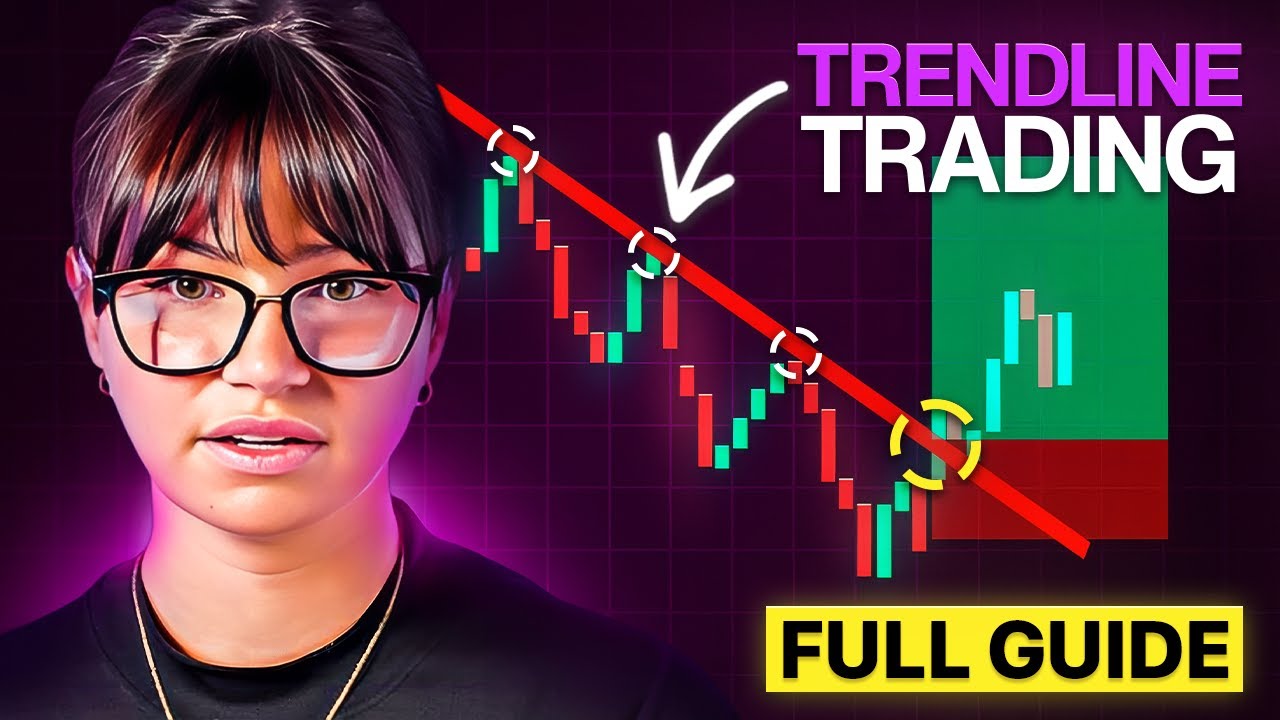
Downward Trend Lines
Must angle downward
Must connect multiple highs
Price cannot cut through the line
Upward Trend Lines
Must angle upward
Must connect multiple lows
Price cannot cut through the line
If price intersects the line, it is invalid.
Trend lines are meant to hold price, not slice through it.
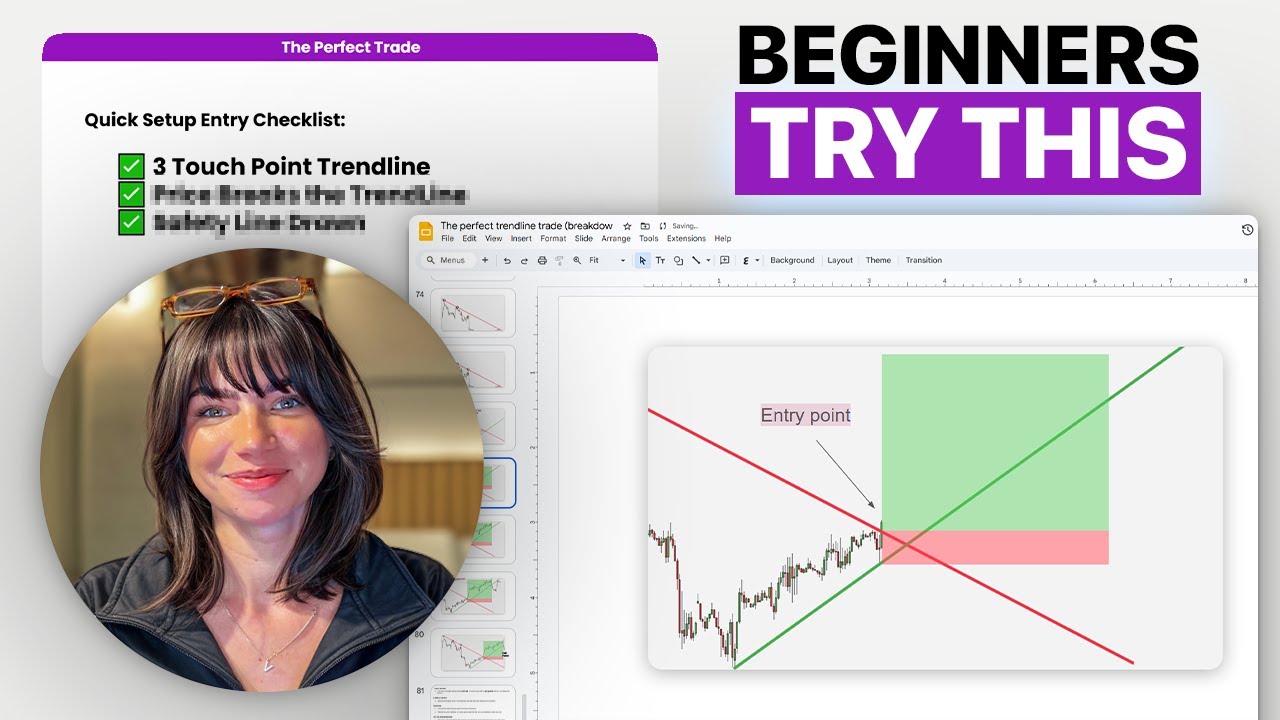
Action Line vs Safety Line
Before a break, trend lines are neutral.
After a break:
The broken line becomes the action line
The opposing line becomes the safety line
The action line tells you when to enter.
The safety line tells you when to exit.
This removes guesswork entirely.
What Makes a Setup Low Risk
A low-risk setup has:
Clearly defined entry
Clearly defined exit
Small, controlled downside
Asymmetrical upside
If your potential loss feels like a fee, you’re trading correctly.
Stop Loss Placement (Non-Negotiable)
Your stop loss:
Always goes on the other side of the safety line
Never sits directly on the safety line
Acts as your fire extinguisher
If price breaks the safety line, the trade is over. No exceptions.
Risk Management Rule of Thumb
For most traders:
Risk 1–2% of total capital per trade
Examples:
$3,000 account → ~$60 risk
$5,000 account → ~$100 risk
$100,000 account → ~$1,000–$2,000 risk
Risk scales with experience, but consistency comes first.
Core Trend Line Setups
All setups use the same system. Only the entry behavior changes.
1. Trend Line Break
Price breaks the action line
Entry occurs on the break
Exit occurs when safety line breaks
This is the core setup and foundation of the system.
2. Two-Touch & Three-Touch Trend Line Breaks
These setups measure how many times price respected the line before breaking.
More touch points = stronger structure
Same rules, same execution
Used for deeper analysis and tracking
3. Break and Retest
Price breaks the action line
Pulls back and retests it from the opposite side
Entry occurs on the retest
Exit still governed by the safety line
This setup often offers tighter risk.
4. Bounce Setup
Price does not break
Price bounces off the trend line
The trend line acts as both action and safety
Exit occurs when price finally breaks the line
This is an advanced variation used selectively.
Why This Strategy Scales Across Markets
You cannot tell:
The instrument
The market
The timeframe
From the chart alone—and that’s the point.
Because this system relies purely on price action and structure, it works on:
Stocks
Futures
Forex
Crypto
Any timeframe
Trading as a Science Experiment
Setups are hypotheses.
Trades are experiments.
Journals are data.
Tracking allows you to:
Identify which setups work best
Eliminate emotional decision-making
Scale position size responsibly
Prove consistency before risking more
Journaling Is Not Optional
You must track:
Setup type
Entry and exit
Risk amount
Outcome
Emotional state
Without data, you are guessing.
With data, you are refining.
When to Increase Position Size
Never increase size until:
You have consistent data
Losses are controlled
Winners outweigh losers
The strategy is repeatable
Size follows consistency — not confidence.
Final Takeaway
This strategy works because it is:
Rule-based
Simple
Repeatable
Risk-first
If you can draw lines and follow rules, you can trade this system.
The edge is not complexity.
The edge is discipline.